1. Introduction: Architecture Driven by Resource Constraint
This handbook defines the specific technical architecture we use to generate official project documentation (Changelogs, Release Notes) leveraging the local, resource-constrained Small Language Models (SLMs) (1B to 14B parameters).
The key distinction from larger, cloud-hosted LLMs (like GPT-4 or Gemini) is the resource scarcity typical of local, commodity AI engineering stacks (e.g., VRAM pools of 12GiB to 48GiB). This necessitates a highly optimized, modular approach.
The Core Principle: Decoupling Efficiency
We implement a Decoupled Documentation Pipeline. This is the architectural standard. We explicitly avoid the common anti-pattern of passing massive, raw data (like a complete git diff/log -p output) to the SLM in one monolithic prompt. This anti-pattern causes VRAM saturation, OOM errors, and non-deterministic latency.
Instead, we shift the heavy lifting (parsing, filtering, aggregation) to lightweight, non-LLM tools and use the SLM only for the final, low-context, high-value step of transformation and summarization.
Target Audience
This document is mandatory for all MLOps Engineers, Architects, and Senior Developers responsible for managing release automation and maintaining the local AI tooling stack (aider, ollama, HuggingFace).
2. The Staged Documentation Flow and Dependency
Our process is defined by three distinct, independent stages. The architecture’s robustness is entirely predicated on the strict enforcement of the Conventional Commit Standard (defined in the “Production Git Workflow Standards” handbook).
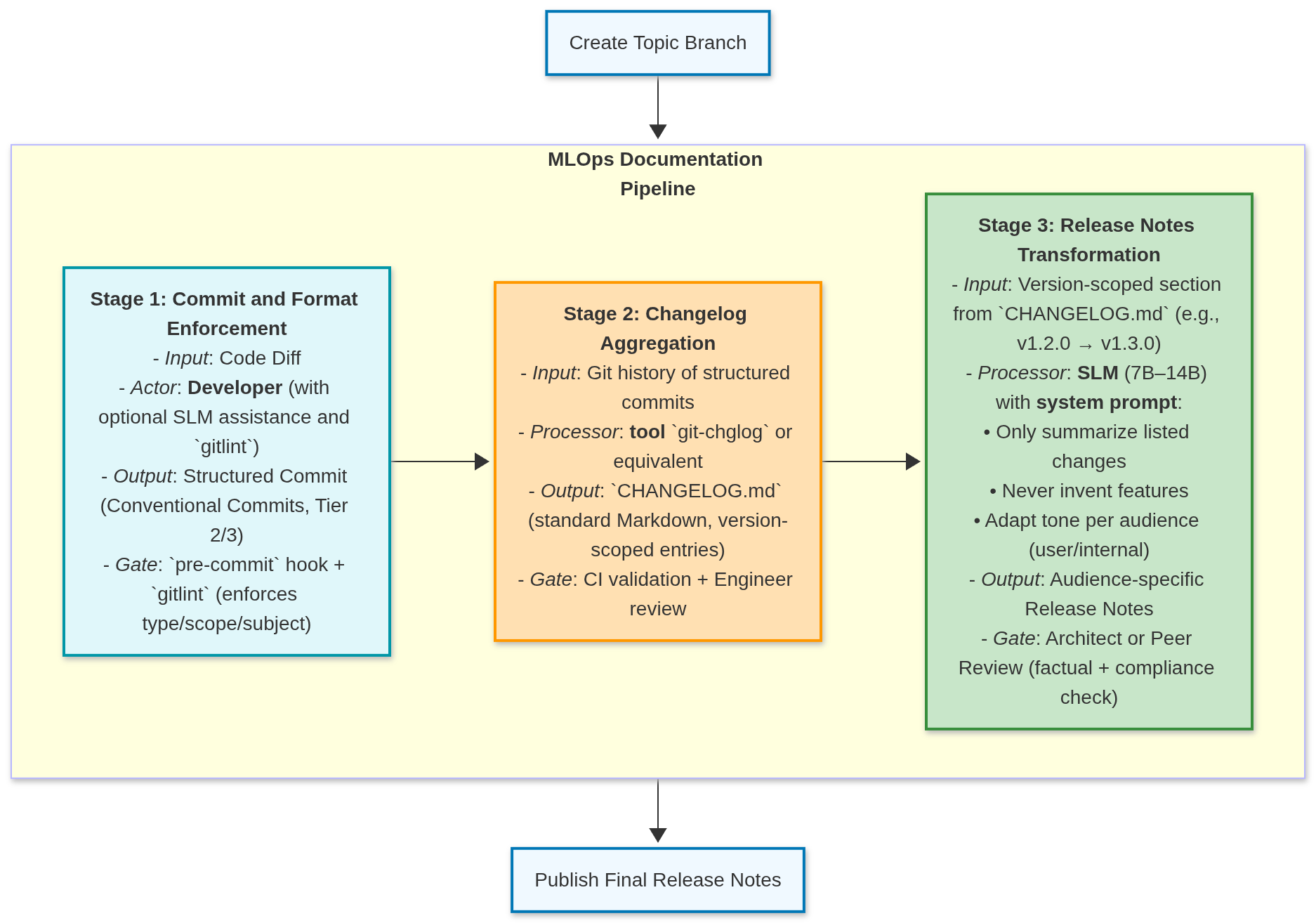
2.1 The Architectural Flow Diagram
The following diagram illustrates how the enforced commit standard is processed through the stages to produce the final release artifacts. Note that Stage 1 is primarily a Developer task, but we are aimed to make it SLM-assisted stage also - generatin commit title and body using the small git diff file (REMEMBER: commits should be atomic and self-contained).
Diagram Legend: MLOps Documentation Pipeline
This diagram illustrates the end-to-end workflow for generating auditable, audience-appropriate release documentation in resource-constrained SLM environments. It enforces separation of concerns by assigning each stage to the most appropriate actor:
Stage 1 (Blue – Developer): Developers structure commits using Conventional Commits (Tier 2/3), optionally assisted by an SLMs or tools like
gitlint. Enforcement occurs via pre-commit hooks.Stage 2 (Orange – Deterministic Tooling): A standards-compliant, non-LLM tool (
git-chglog) aggregates commits into a machine-readableCHANGELOG.md. Validated by CI and engineers.Stage 3 (Green – SLM): A capable SLM (7B–14B), guided by engineered prompts, transforms raw changelog entries into tailored release notes (e.g., for users vs. internal teams). Requires architect or peer approval.
I/O Stages (Light Blue): Represent workflow boundaries—branch creation (input trigger) and final publication (output artifact).
Design Principle: Use the smallest effective component for each task
human judgment for intent,
deterministic tools for structure, and
SLMs only where natural language adaptation is required.
Avoid LLM overuse and ensures reproducibility.
3. SLM Allocation and Resource Strategy
The core design choice is assigning the smallest viable model to the most frequent tasks. This ensures optimal latency and predictable, minimal VRAM consumption across heterogeneous local stack.
3.1 Stage 1: Commit Message Generation
| Parameter | Specification | Rationale |
|---|---|---|
| SLM Size | 1 Billion to 3 Billion | Task is highly constrained: adherence to a format and summarization of a small, local diff. Minimal VRAM is required for near-instant inference, supporting high-frequency use. |
| Input Context | Low. Single commit diff + the concise prompt template. | Maximally low token count. Prevents VRAM pressure during high-frequency development use. |
| Tooling | aider (CLI agent) in /ask mode and with --no-git and --read-only flags to prevent implicit context loading from the codebase. | The tool is used only for drafting text output, preventing code mutation and ensuring process idempotency. |
3.2 Stage 2: Changelog Aggregation (The Non-LLM Gate)
This stage is primarily handled by standard, non-LLM command-line tools. This is the Critical Architectural Choice that removes the complex, high-cost, and non-deterministic context-saturation risk entirely.
| Parameter | Specification | Rationale |
|---|---|---|
| SLM Size | Not Used. | Computational Efficiency & Cost Avoidance. Using an SLM for deterministic parsing is computationally inefficient. Lightweight, non-LLM tools execute this process near-instantly on the CPU, avoiding the VRAM load, latency, and token costs associated with even a short LLM prompt. |
| Tooling | git-chglog (or similar). | These tools use simple regex and parsing logic to reliably aggregate the structured commit history into the standard CHANGELOG.md format. |
3.3 Stage 3: Release Notes Transformation
This is the final, high-value task where the largest SLM is justified. The goal is to transform the developer-focused Markdown into an audience-focused narrative (e.g., executive summary, customer email).
| Parameter | Specification | Rationale |
|---|---|---|
| SLM Size | 7 Billion to 14 Billion | Requires complex linguistic capabilities (tone, style, summarization, abstraction). The higher parameter count is necessary for quality, as the task is less frequent (only at release). |
| Input Context | Low-to-Medium. Only the relevant, clean section (e.g., the ## vX.Y.Z block) from CHANGELOG.md is provided. | Context is short, clean, and pre-categorized. The prompt asks the SLM to act as a text transformer, not a complex parser. |
| Prompt Focus | Instructional/Transformative Prompt. | The prompt explicitly details the target audience (e.g., “Write this for a non-technical manager”) and the required tone. |
4. Resource Pitfalls and Technical Debt
New engineers must understand the specific constraints that mandate this architecture. Deviating from these constraints will result in production failures.
4.1 Hidden Debt: Context Window Inflation
The most significant risk is a developer attempting to increase the SLM’s context size by modifying the system prompt or adding unnecessary input data at Stage 3.
Risk: Even a short, clean changelog list, if followed by an unnecessarily large or verbose system prompt, can push a mid-sized SLM over the edge, causing latency spikes or Out-of-Memory (OOM) errors.
Mitigation: System prompts for SLMs MUST be highly compact, using JSON or constrained Markdown templates instead of verbose prose. All prompts must be version-controlled alongside model configs to prevent drift between prompt behavior and model quantization performance.
Every token is a resource cost.
4.2 The Anti-Pattern: Monolithic Processing
Avoid any attempt to use a single SLM (even the 14B model) for both raw code analysis (Stage 1) and final summarization (Stage 2/3) simultaneously.
Why it Fails: Combining raw diff analysis and release note generation in one SLM pass forces the model to juggle low-level syntactic noise and high-level semantic summarization. This leads to:
Loss of composability: Violates the Unix philosophy—each stage should do one thing well.
Prompt instability: Long, heterogeneous prompts (diffs + templates + instructions) cause attention dilution and hallucination.
Operational fragility: Context lengths grow unpredictably with PR size; even 14B models with 4-bit quantization fail on >8K tokens under concurrent load.
Non-reproducibility: Small diff changes cause large output variance due to attention reallocation.
Empirical evidence: In SLM pipelines, decoupling deterministic preprocessing (e.g., git diff --name-only, AST extraction) from LLM summarization reduces failure rate by 3–5× and improves cache hit ratio in CI.
4.3 Mandatory Human Audit Gates
The “Manual Review & Edit” steps are MANDATORY AUDIT GATES against SLM errors and parsing failures. They are not optional:
Stage 2 Audit: Verify the non-LLM tool correctly grouped and categorized all relevant commits from the specified range.
Stage 3 Audit: Verify the SLM-generated release notes accurately reflect the facts in the changelog and use the correct professional tone. Do not trust the SLM’s stylistic choices without review.
4.4 Prompt injection via commit messages
A malicious or malformed commit body (e.g., containing }} {{") could break JSON-formatted system prompts in Stage 1 or 3, leading to prompt leakage or role confusion.
Mitigation: All commit message fields used as LLM input must be sanitized: (1) escape double quotes and braces, (2) truncate to max 200 chars per field, (3) validate against allow-list of Conventional Commit types. Never interpolate raw git log output directly into prompts.
5. Architectural Rationale: Monolithic vs. Decoupled
The choice of the Decoupled Documentation Pipeline is an architectural imperative driven by the resource constraints of the SLM stack. This decision ensures high performance, reliability, and low operational cost, directly contrasting the brittle and resource-heavy “Monolithic” anti-pattern.
The Monolithic Anti-Pattern
The monolithic approach attempts to use a single large prompt to feed raw, unparsed data (e.g., hundreds of lines of git diff -p) directly into the SLM for processing and summarization.
The Decoupled Solution (Our Standard)
We use lightweight tools to parse the structured Conventional Commits first, and only feed the clean, minimal context (i.e., the changelog entries) to the SLM for the final transformation step.
| Architectural Dimension | Monolithic Anti-Pattern (Raw Diff LLM) | Decoupled Solution (Commit Tool LLM) |
|---|---|---|
| SLM Role | Parser and Summarizer (High-Cost Data Processing) | Contextual Transformer (Low-Cost Stylistic Adaptation) |
| Input Context | Extremely High (Raw diffs: hundreds of lines of code). | Very Low (Structured commit summaries: tens of lines of text). |
| VRAM/RAM Load | Critical: High risk of Out-of-Memory (OOM) error. complexity on large . | Minimal: Predictable, low-peak memory usage. |
| Latency/Speed | High and Unpredictable (Slow token generation). | Fast and Predictable (Rapid generation on short context). |
| Failure Point | Brittle: Single failure (OOM or prompt misinterpretation) breaks the entire release notes generation. | Robust: Failure in one stage is localized; the LLM stage is highly reliable due to clean input. |
| Operational Cost | High (GPU hours, retries, development complexity) | Low (CPU work + brief, predictable GPU burst) |
| Applicability | Only viable for large, cloud-hosted LLMs with massive memory pools. | Mandatory for resource-constrained local SLMs (1B-14B). |
Appendix A. AI-Assisted Documentation Flow